


Everything posted by nine¾
-
 My mistake, I was typing Alen* xD (updated post for M)
-
A band that used a shortened version of its name when it first charted in the UK. Around the release of Unfinished Sympathy, Massive Attack temporarily shortened their name to Massive, dropping 'Attack' because of sensitivities surrounding the Gulf War. The single went on to become their first UK Top 20 hit, peaking at #13. Manic Street Preachers Their first UK chart entry was Motown Junk in 1991, and they were already credited under their full name, Manic Street Preachers. They are often informally shortened to the Manics, but I couldn’t find any evidence that they actually charted under that shortened name. Maroon 5 Their first UK chart entry was Harder to Breathe in 2004, and they were already credited as Maroon 5. Before that, most of the band had performed as Kara’s Flowers, but that was a completely different name rather than a shortened version of Maroon 5, so it doesn’t match the clue. My Chemical Romance Their first UK chart entry was Headfirst for Halos in 2004, and they were already credited under their full name, My Chemical Romance. Although the band are commonly shortened to MCR or My Chem, I couldn’t find any evidence that they actually charted under either of those shortened names. MGMT The band were originally known as The Management before shortening their name to MGMT. When they first entered the UK Singles Chart with 'Time to Pretend' in 2008, they were already using the shortened name. Since the clue only requires the band to have used a shortened version of its name when it first charted in the UK, this qualifies. Matchbox Twenty They first appeared on the UK chart as 'Matchbox 20', and later expanded the '20' to 'Twenty', becoming Matchbox Twenty. I think the clue is worded broadly enough for this to be a fair answer to accept. McFly They first charted in the UK as McFly with '5 Colours in Her Hair', and I couldn’t find any longer version of the band’s name that they had shortened for their first chart appearance. Mini Viva They were already using the name Mini Viva before their first UK chart appearance, and I couldn't find any evidence that it was a shortened version of an earlier band name used when they first charted. Münchener Freiheit This works as an alternative answer. The band's full name is Münchener Freiheit, but they used the shortened name Freiheit for their English-language releases. Their first UK chart hit, 'Keeping the Dream Alive', entered the chart in 1988 credited simply to Freiheit, so it fits the clue.


-
An artist whose first UK Number 1 followed a rise to fame through MySpace. Before her breakthrough, Lily Allen began posting demos on MySpace, where she quickly built an audience of tens of thousands. Her growing online popularity attracted media attention and earned her the nickname 'Queen of MySpace'. Soon afterwards, her debut single 'Smile' reached Number 1 on the UK Singles Chart in 2006. Lewis Capaldi His first UK Number 1 came with Someone You Loved in 2019, many years after the MySpace era had effectively ended. His rise to fame therefore came much later and wasn’t part of the MySpace-driven wave of artists the clue is referring to. Lady Gaga Just Dance was indeed her first UK No. 1, but her rise to fame wasn't through MySpace. The MySpace part is key to the clue, referring to an artist whose online popularity there directly preceded their mainstream breakthrough and first UK No. 1.


-
K = K An album that ends with a recording of the founder of an international spiritual movement. K is the 1996 debut album by British psychedelic rock band Kula Shaker. It was a major success in the UK, reaching #1 on the UK Albums Chart. The album reflects the band's strong interest in Indian music and spirituality, most notably through songs such as Govinda, which is sung entirely in Sanskrit. After the final listed track, the album also contains a hidden recording of A. C. Bhaktivedanta Swami Prabhupada, the founder of the Hare Krishna movement, speaking about his spiritual teacher. Kaleidoscope There are actually quite a few albums called Kaleidoscope, so I checked several possibilities, including the albums by Kelis, Siouxsie and the Banshees, but I couldn’t find any that end with a recording of the founder of an international spiritual movement or something like that. Kings and Queens Same situation as with Kaleidoscope Kendrick Lamar – Mr. Morale & the Big Steppers Unfortunately, no points here. A spiritual figure, Eckhart Tolle, does appear on the album, so there is some connection to the clue. However, the clue specifically asks for an album that ends with a recording of the founder of an international spiritual movement. Mr. Morale & the Big Steppers ends with 'Mirror', where Tolle doesn’t appear, and he is not the founder of such a movement, so it doesn’t meet the key parts of the clue. Also, the clue specifically asked for the name of an album, while Kendrick Lamar is the artist, so that wouldn’t count as an album answer either. KAYA Kaya contains strong Rastafarian and spiritual themes, including references to Jah. However, the album ends with TIme Will Tell, and there is no recording of the founder of an international spiritual movement at the end. The spiritual connection therefore fits the general theme, but not the specific requirement of the clue. KPOP DEMONS HUNTERS Unfortunately, no, the soundtrack doesn’t end with a recording of the founder of an international spiritual movement. It ends with 'Score Suite' by Marcelo Zarvos KULA SHAKER The artist’s name was given instead of the album title, which should have been K, so I’m giving you half the points for this one - 1 point. I’m deducting a point here to stay consistent with how I’ve scored spelling errors, since in both cases the intended answer is clear but the answer given isn’t fully correct.


-
Yes, your other answer is included under a different letter <3 Will continue soon
-
I'm all for moving Bror and Jade to SF2 now that I've sent pop! If I don't qualify with this... 😈
-
J = A song that reportedly got a record executive excommunicated by the Vatican. Recorded by Serge Gainsbourg and Jane Birkin, Je T’aime… Moi Non Plus caused considerable controversy upon its release in 1969. The song was banned by the BBC and in several countries because of its suggestive content, while the Vatican publicly condemned it and reportedly excommunicated the record executive responsible for its release in Italy. Despite the controversy, it went on to reach No. 1 on the UK Singles Chart, becoming the first non-English-language song to do so. When it was released in 1969, its sexually suggestive vocals and lyrics caused an extraordinary amount of controversy. Radio bans or restrictions were imposed in numerous countries. Among those where it was banned from radio were the UK, Italy, Spain, Sweden and Brazil, while other contemporary accounts also list countries such as Iceland, Poland, Portugal and Yugoslavia. In France, rather than being banned outright, it could not be played on the radio before 11 p.m. The reaction in Italy was particularly extreme. RAI refused to broadcast the record, and as the song continued climbing the Italian sales chart, presenter Lelio Luttazzi was eventually forbidden even from announcing its title or chart position. L’Osservatore Romano, the Vatican newspaper, publicly condemned the song as obscene, and the record executive/distributor responsible for its Italian release was reportedly excommunicated. The controversy then went beyond broadcasting censorship. On 28 August 1969, prosecutors in Milan ordered copies of the record to be seized and destroyed throughout Italy on obscenity grounds. Hundreds of copies were confiscated from the distributor, but the record continued to circulate illegally and its black-market price reportedly rose dramatically. The UK produced another remarkable contradiction. The BBC banned the song from its airwaves and even refused to feature it normally on Top of the Pops, yet the public continued buying it. 'Je t’aime… moi non plus' ultimately reached No. 1 on the UK Singles Chart, becoming a particularly famous example of censorship failing to prevent and arguably helping to fuel a record’s commercial success. JUSTIFY MY LOVE 2 points for connecting the clue well with the letter. I can see the reasoning, especially given the controversy around the song and Madonna’s wider connection with religious/Vatican controversy. However, I couldn’t find any record executive being excommunicated because of Justify My Love. JAY-Z The clue was matched to the wrong letter, also Jay-Z has had several UK No. 1 collaborations with female artists, including Beyoncé and Rihanna. However, these are generally credited as featured collaborations rather than duets, and Run This Town also includes Kanye West, making it a three-artist collaboration. Since the clue specifically refers to the artist's two highest-charting singles being duets with female artists, I don't think Jay-Z quite fits this one. JOHN TRAVOLTA John Travolta is a very close answer, as his two highest-charting UK singles, You're the One That I Want and Summer Nights, were both duets with Olivia Newton-John. However, the clue specifically says 'duets with female artists' in the plural, referring to two different female artists rather than two duets with the same person. So while the connection is very close, it doesn't quite meet that condition. JUSTIN BIEBER Justin Bieber did achieve a UK No. 1 at the age of 18: Believe topped the UK Albums Chart in 2012. However, that was his only UK No. 1 at the time. Boyfriend peaked at #2, and he didn't achieve his first UK No. 1 single until 2015 with What Do You Mean?. So while he had a No. 1 at 18, he didn't hold two UK No. 1s simultaneously. Juice WRLD I'm assuming this was meant for the posthumous No. 1 clue. There is a connection, as Juice WRLD did achieve a UK No. 1 after his death, but he had already appeared on the UK charts during his lifetime, most notably with Lucid Dreams, which reached #10 in 2018.


-
It wasn't literally banned, it was just included on a list of songs considered inappropriate for airplay during the Gulf War, which I personally find pretty WTF.
-
waiiiiiiiitt corrected
-
Interesting, while I was writing that post and waiting my ride this song came on Video
-
I = A song that was once considered inappropriate for BBC airplay because of its pacifist message. During the Gulf War in 1991, the BBC circulated a list of songs that were considered potentially inappropriate for radio airplay because of the conflict. Among them was John Lennon’s 'Imagine'. Despite its pacifist message, the song was considered sensitive in a wartime context, particularly because of its vision of a world without countries or conflict. The list was intended as guidance for broadcasters rather than a formal ban, and included dozens of other seemingly unlikely songs. The case of John Lennon’s 'Imagine' is particularly interesting because the song was not anti-war in a traditional sense. Instead of criticizing a specific country or conflict, Lennon imagines a world without countries, borders, religion, or reasons for people to fight. Lines such as 'Imagine there’s no countries' and 'nothing to kill or die for' directly challenged ideas of nationalism and conflict. It is also important to note that 'Imagine' was not an anti-war song in the traditional sense. Lennon does not refer to a specific war, attack any particular country, or call for political protest. Instead, he imagines a radically different world in which the very foundations that divide people have been removed. Because of this, the song could be interpreted as a political or controversial statement, even though its central message was universal and pacifist. IRIS By 'a 2010s single' I intended a single originally released during the 2010s, whereas 'Iris' was originally released in 1998. However, it did chart as a UK single during the 2010s and first reached the Top 5 in 2011, more than a decade after its original release, so I think the wording leaves enough room for that interpretation. Since it fits the rest of the clue perfectly, I'll accept it. But becouse of wrong letter its 2/4. (From a UK chart perspective, it does count as a 2010s single, so..) I AM THE WALRUS 'I Am the Walrus' was indeed considered inappropriate for BBC airplay, but for a completely different reason: the BBC objected to the word knickers in the lyrics. I also couldn't find a pacifist or anti-war message in the song that would bring it close to the clue in the way some of the other answers do, so I can't award the points for the answer itself. Of course, you still get 2 points for correctly matching the clue to the letter! IN THE AIR TONIGHT This was actually included on the same BBC list of 67 songs considered potentially inappropriate for airplay during the 1991 Gulf War as Imagine, so you definitely connected the clue to the right event. The reason for its inclusion was different, though. In the Air Tonight isn’t a pacifist song, it’s a personal song associated with anger and the breakdown of a relationship, and it appears to have been included because its title could carry unfortunate associations in the context of the war. IV The clue was matched with the wrong letter, but the answer itself is valid for that clue. There are albums titled simply IV that are indeed their respective artists’ fourth studio albums, so the answer satisfies the clue. Therefore, you get 2 points for the correct answer, but not the 2 points for matching the clue to the correct letter. IN THE ARMY NOW / I LOVE MAN IN UNIFORM I Love a Man in Uniform was taken off BBC airplay during the Falklands War, and Andy Gill described it as an anti-war song, with its message also described as critical of militarism. However, I couldn't find a source specifically describing its message as pacifist. In the Army Now can likewise be interpreted as an anti-war song, particularly in relation to the Vietnam War, but I couldn't find reliable evidence that the BBC considered it inappropriate for airplay specifically because of a pacifist message. Anti-war and pacifist aren't necessarily interchangeable: a song can criticise a particular war, the military or militarism without advocating pacifism more broadly. However, given how close both answers are to the idea behind the clue, and the understandable overlap and potential confusion between 'anti-war' and 'pacifist' in this context, I'm giving both 1 out of 2 points for the right answer + 2 for the right clue, so that's 3. IKE TURNER I can see the reasoning behind Ike Turner, but the issue is that Ike & Tina Turner were charted as a separate act rather than those songs being credited to Ike Turner as an individual artist duetting with Tina. The clue refers to a male artist whose own two highest-charting UK singles were duets with female artists, so the Ike & Tina Turner chart entries can't be counted as Ike Turner's individual singles, they are like band. IAN VAN DAHL Ian Van Dahl doesn't fit this clue because, despite sounding like a person's name, Ian Van Dahl is actually a Belgian dance project rather than a male solo artist.


-
A song that had three different versions in the UK Top 40 at the same time. In December 2008, three different versions of 'Hallelujah' appeared in the UK Top 40 at the same time. Alexandra Burke’s version, released after her X Factor victory, reached #1, while Jeff Buckley’s 1994 recording climbed to #2 following a fan campaign. The renewed interest also pushed Leonard Cohen’s original version into the UK chart for the first time, reaching #36 - more than two decades after its release (that's criminal if you ask me #loveforcohen) HEY JUDE Although Wilson Pickett’s cover also became a UK Top 40 hit, reaching #16 in 1969, it didn’t overlap in the Top 40 with The Beatles’ original. I also couldn’t find a third version that charted alongside them, so there were never three different versions of Hey Jude in the UK Top 40 at the same time


-
Sure, sorry I didnt see no more reservations for UK Charts
-
Under normal circumstances, I wouldn’t do the presentation at the same time as the listening-through, but it is what it is right now. I’ll have even less time tomorrow, so I’ll just try to post whenever I get the chance. Thank you for reading explanations too x
-
I’m not even from Britain, and they were actually one of the first bands I ever heard in my life :/
-
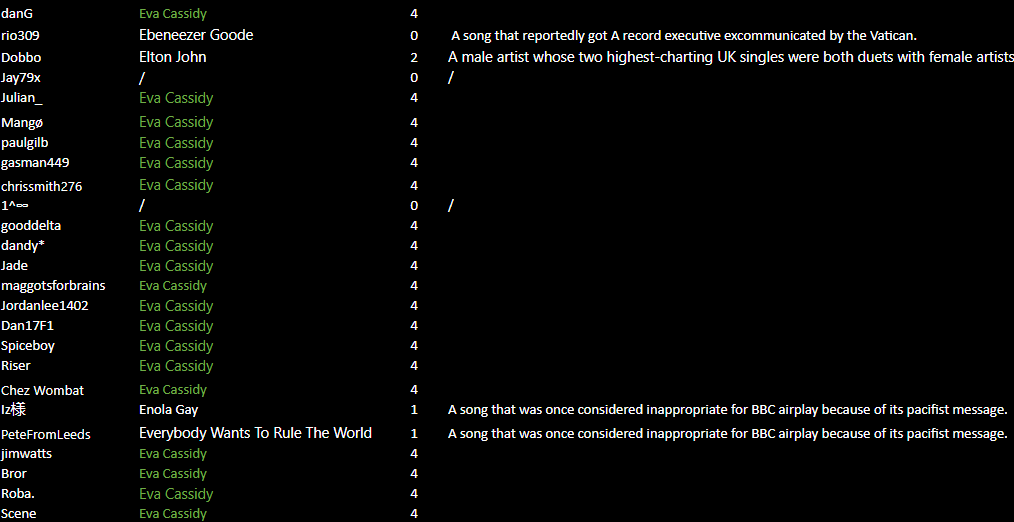
If I calculated everything correctly (I’ll double-check later), this would be the situation from A to G. Now I have to pack for tomorrow, and in the morning I’m planning to post a few more answers. danG 18 gasman449 18 gooddelta 18 Riser 18 Bror 18 Julian_ 17 dandy* 17 Jade 17 Mangø 16 chrissmith276 16 Dobbo 14 paulgilb 14 maggotsforbrains 14 Dan17F1 14 jimwatts 14 Spiceboy 13 Roba. 12 Jordanlee1402 11 PeteFromLeeds 11 1^∞ 10 Chez Wombat 10 Scene 9 rio309 6 Jay79x 6 Iz様 6
-
A 2010s single that first reached the UK Top 5 over a decade after its release. Originally released by The Chemical Brothers in 2015, Go peaked at No. 46 on the UK Singles Chart. Eleven years later, after gaining renewed popularity through the Netflix film Apex, the song reached a new peak of No. 4. sorry for quality GAY BAR There is a connection here, as the references to war in “Gay Bar” were censored for airplay around the beginning of the Iraq War. However, I couldn't find evidence that this was specifically a BBC decision, and more importantly, the song itself doesn't have a pacifist or anti-war message. Dick Valentine actually said that the reference to starting a war wasn't intended as a political statement. So unlike some of the other anti-war answers I've given partial credit for, this one doesn't quite fit the central idea of the clue. Give Peace A Chance This is a correct answer to the clue, but it was matched with the wrong clue. 2/4 Give Ireland Back to the Irish This was also matched with the wrong clue. The song was indeed banned by the BBC, but for its explicit political stance on Northern Ireland, not because of a pacifist message. Gnarls Barkley with Crazy The clue was matched to the wrong letter, but the answer given for it was very, very close. However, Gnarls Barkley don’t quite fit. Crazy was deliberately withdrawn from physical sale after nine weeks at No. 1, but they didn’t do it to prevent the song from matching a long-standing chart record, importantly, by that point it had already matched Bohemian Rhapsody with nine weeks at No. 1. The stated reason for withdrawing it was more about avoiding overexposure and moving on to the next single, so it doesn’t quite meet the specific condition in the clue. Gareth Gates good connection again, as he had multiple UK No. 1 singles at a very young age. However, those No. 1s came at different times, and his debut album peaked at #2, so he didn't actually hold two UK No. 1 positions simultaneously at 18.


-
F - An act whose hit was recorded without conventional instrumental accompaniment. The Flying Pickets reached Number 1 in 1983 with their a cappella cover of Yazoo’s Only You, performed without conventional instrumental accompaniment. It became the first a cappella recording to top the UK Singles Chart and remained at Number 1 for five weeks, including the Christmas chart. FRANK SINATRA Frank Sinatra doesn't quite fit this clue. His hits were recorded with conventional instrumental accompaniment, for example, Strangers in the Night was recorded with a large orchestra, including guitars, bass, drums and organ. I also couldn't find a Sinatra hit that was recorded without conventional instruments, which is the specific condition required by the clue. Florence + the Machine 1There is definitely some basis for this answer. Dog Days Are Over is often described as having been recorded without instruments, and Florence herself has said that the song originally came together with no instruments, using vocals and improvised percussion instead. So I can see why this answer fits the wording of the clue. However, the actual released recording of Dog Days Are Over does feature conventional instruments. Its official recording credits include guitar, bass, piano, harp, cello, violin, viola and drums. That makes it slightly different from my intended answer, The Flying Pickets, whose Only You is genuinely a cappella and uses voices rather than conventional instrumental accompaniment throughout the recording itself. So I’m giving Florence + the Machine 1 point. The reasoning behind the answer is valid and there are sources describing the song as originating/being recorded without instruments, but the finished recording we actually hear does contain conventional instrumentation. FLOATERS Their only UK chart hit was Float On, and while it reached No. 1, it was recorded with conventional instrumental backing. Since the clue specifically refers to a hit recorded without conventional instrumental accompaniment, Float On doesn’t qualify. FAITHLESS I couldn’t find a Faithless hit that was recorded without conventional instrumental accompaniment, so I don’t think this one fits the clue. If there is one that I’ve missed though, feel free to correct me! FATBOY SLIM I couldn’t find a Fatboy Slim hit either that quite fits this clue. His music does make heavy use of samples and electronic production, but the recordings still contain instrumental elements such as piano, guitar and drums, so they wouldn’t really count as being recorded without conventional instrumental accompaniment. FALCO His UK hit Rock Me Amadeus uses a full instrumental production, including synthesizers, so it wasn't recorded without conventional instrumental accompaniment. FRANK OCEAN Frank Ocean doesn't quite fit this clue either. I checked his charting material, including some of his more stripped-back recordings, but I couldn't find a hit that was recorded without conventional instrumental accompaniment. Even his more vocally focused recordings still use instrumental or electronic backing, so they don't meet the specific condition of the clue.


-
Felt the same without the clue!!
-
No, not at all! You'll just have to wait a little longer for everything now. I'm really glad I did this though, especially since I'd never really followed the UK charts before, and now I've actually become interested in them.
-
There are more mistakes in the first half, but there are still a few in the second half as well.
-
Honestly, over the last few days, every time I saw a correct answer, it felt like the sun had come out
-
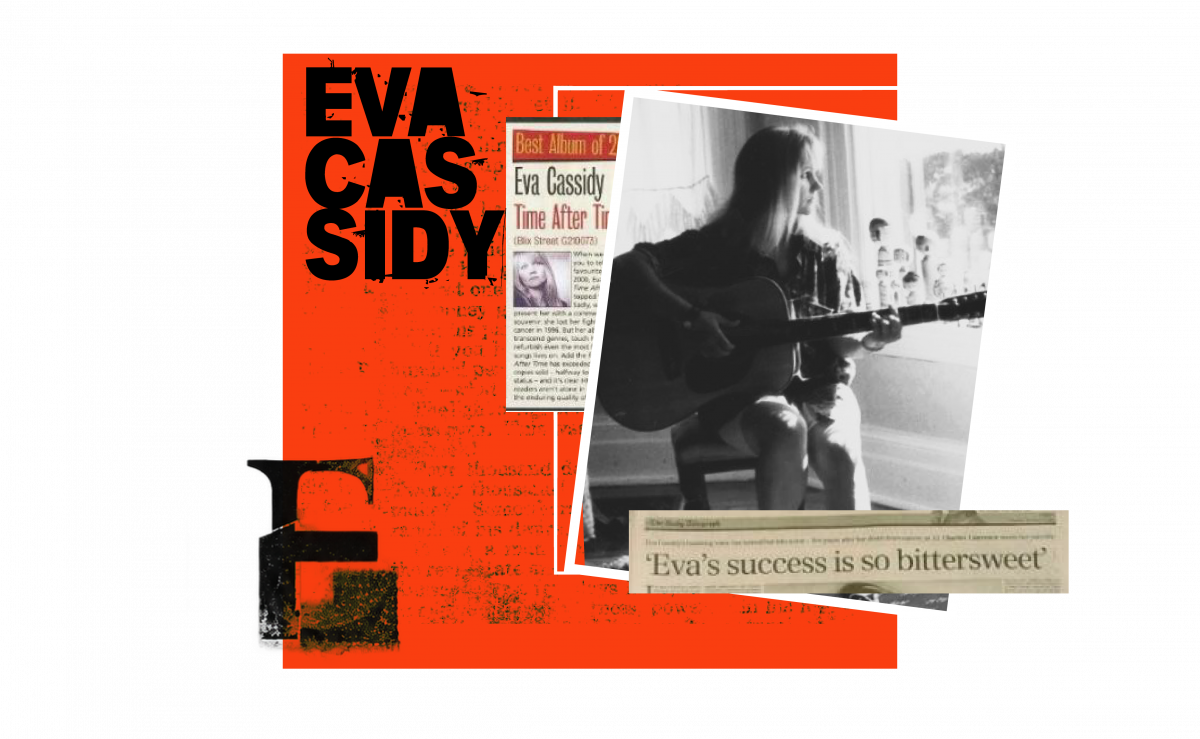
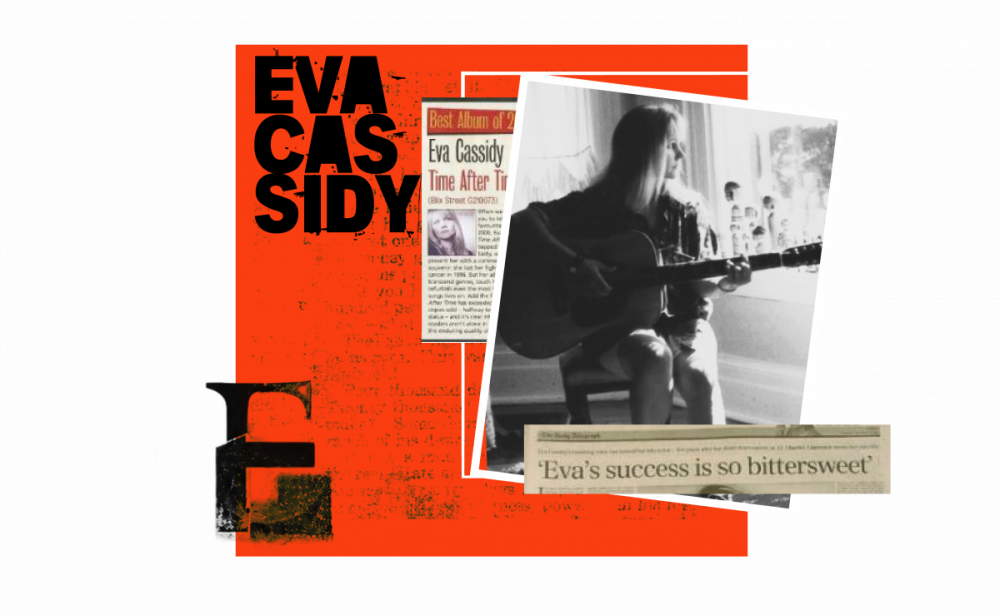
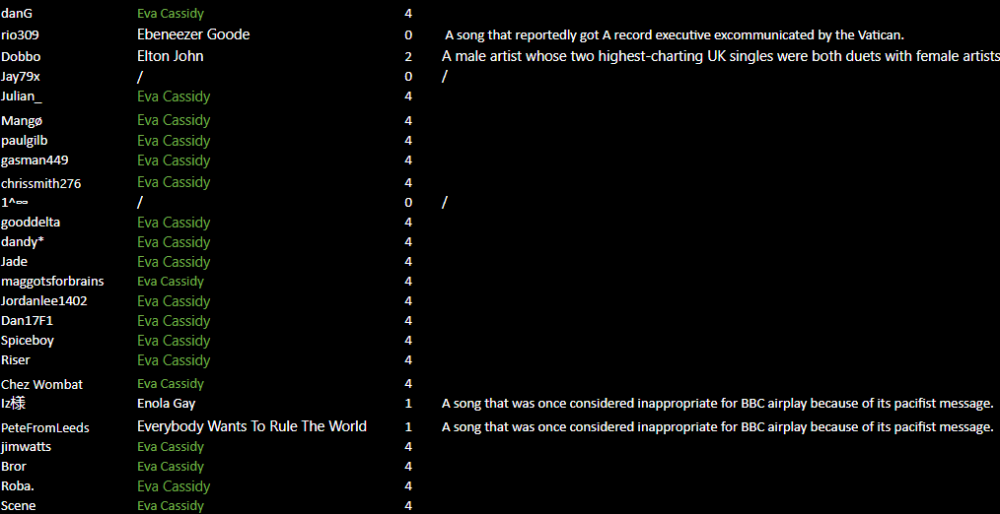
An artist who never appeared on the UK charts during their lifetime, but went on to achieve a UK No. 1 after their death. my intended answer Eva Cassidy never appeared on the UK charts during her lifetime. She died in 1996, largely unknown to the British public, but her music became hugely successful in the UK posthumously. Her album Songbird eventually reached No. 1, and in 2007, eleven years after her death, she achieved her first and only UK No. 1 single with What a Wonderful World, a posthumous duet with Katie Melua that combined Melua’s vocals with Cassidy’s original recording. Now we're getting to the cases where someone gave the correct answer to a clue but matched it to the wrong letter. ELTON JOHN This one has made me realise that my wording was slightly ambiguous. Elton John has had UK No. 1 duets with female artists, including Don't Go Breaking My Heart with Kiki Dee and Cold Heart with Dua Lipa, so technically two of his highest-charting singles do satisfy the condition. He also had several other UK No. 1s, whereas I intended the clue to refer to an artist whose two highest-charting singles could specifically be identified as those two female duets. Since I didn't explicitly rule out other singles reaching the same peak, I'll accept Elton John as a valid interpretation. 2/4 for the right answer, but -2 for the wrong letter Ebeneezer Goode Ebeneezer Goode was given for the clue 'A song that reportedly got a record executive excommunicated by the Vatican', which was matched to the wrong letter here. I still checked the song to see whether it could work as an alternative answer to the clue itself. It certainly caused considerable controversy at the time, but that controversy was unrelated to the Vatican. Everybody Wants to Rule the World and Enola Gay Being anti-war isn't necessarily the same as being pacifist. An anti-war song can criticise a particular conflict, the military or militarism without advocating a broader rejection of war or violence. Since the clue specifically says the song was considered inappropriate because of its pacifist message, I was looking for evidence of that more specific connection, rather than simply an anti-war interpretation. Enola Gay is an anti-war song, so it does fit the general theme of the clue. However, the reason it was considered unsuitable for BBC children’s programming had nothing to do with its anti-war or pacifist message. The issue was reportedly a misunderstanding of the word gay in the title, which was interpreted as a sexual reference. So while the song’s message is relevant, the specific reason for the BBC restriction doesn’t match the clue. Everybody Wants to Rule the World was considered inappropriate for BBC airplay during the Gulf War. However, this was due to its political themes rather than a specifically pacifist message, which is the key part of the clue. BUT.... Still, given their close connection to the idea behind the clue, and applying the same flexibility I've used with other anti-war answers, I'm giving each 1 out of 2 points for the clue itself. There are no additional points for the letter match, since both were matched to the wrong letters.
-
To be fair, I probably wouldn't know how to spell most of these names without checking either, but in this case it's actually a different surname altogether. If you think I've been too harsh, I can change it. 😅
-
A Eurovision winner whose winning song didn't reach the UK Top 40 until two years after the victory. my intended answer Duncan Laurence won Eurovision for the Netherlands in 2019 with Arcade. The song initially peaked at No. 67 in the UK, but gained a new wave of popularity two years later and re-entered the chart, eventually reaching a new peak of No. 29 and becoming a UK Top 40 hit for the first time. Duncan Lawrence I know you meant Duncan Laurence, so I’m still giving you a point here! Since Lawrence is a different existing surname rather than just a small typo, I can’t quite give the full 2points for right answer, so 1 point for answer + 2 points for matching with right clue. 3/4